Lake Mead Striped Bass · 2026 Tactics
Striped Bass Fishing on Lake Mead: Tactics That Work in 2026
Stripers boil at first light and sound at noon. Here's how to find them, mark them and stick them — every month of the year.
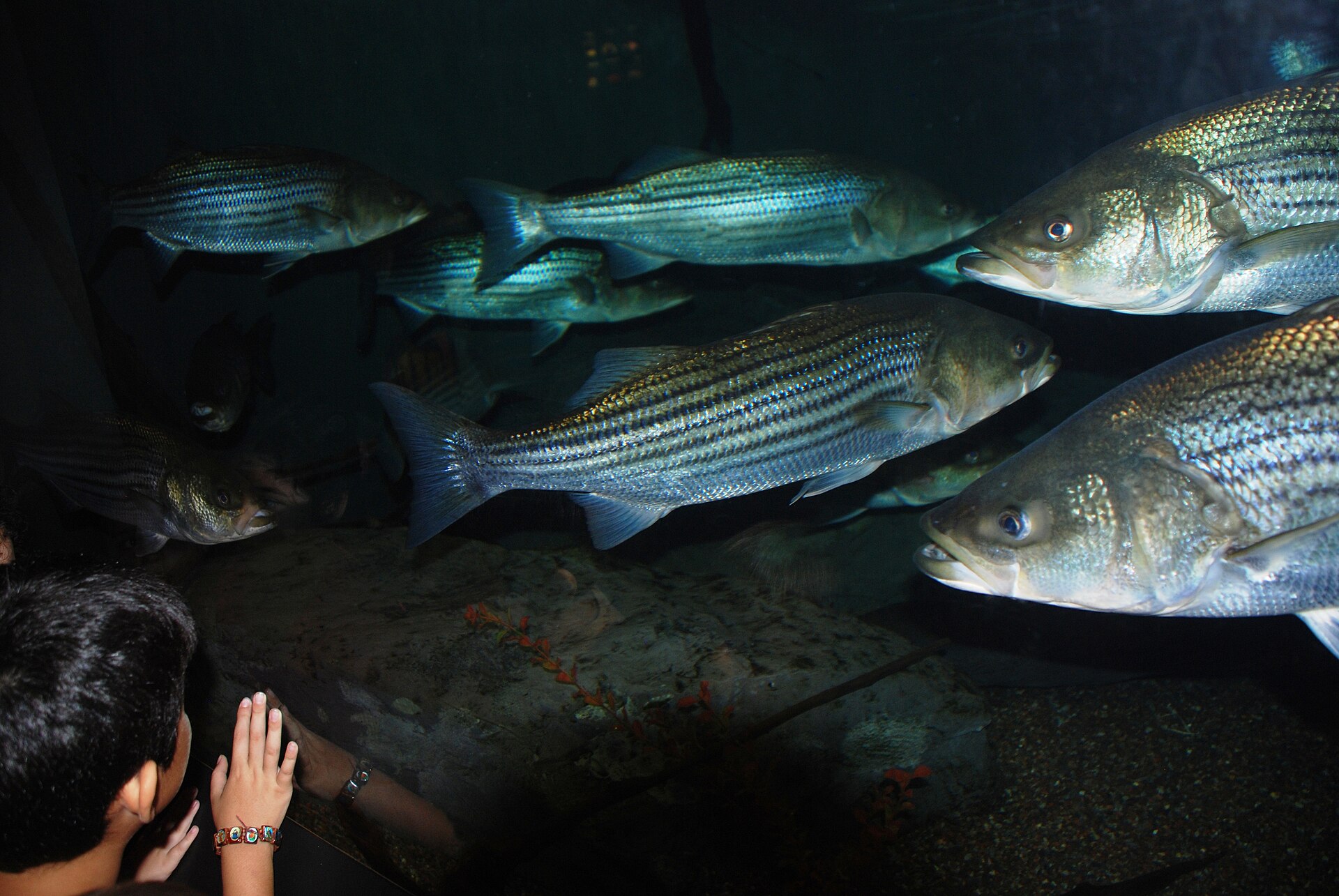
The first time you see a Lake Mead striper boil — a half-acre of water exploding as 4-pound schoolers herd a ball of threadfin shad to the surface, gulls overhead, fish busting in every direction — you understand why people drive eight hours to be at Hemenway Harbor before sunrise.
Striped bass are the most exciting fish on Lake Mead and, depending on the season, the most cooperative. They're also moving targets — schoolers cover ground, suspended schools shift depth hourly, and the difference between a hot day and a slow one is almost always how well you're reading water (and sonar). This guide is the editorial team's 2026 striper playbook for Mead.
The basic biology
Striped bass (Morone saxatilis) are anadromous in their native East Coast range, but the population in Lake Mead is fully landlocked and self-sustaining. They grow to legitimate trophy size on a diet that's overwhelmingly threadfin shad, with seasonal contributions from juvenile gizzard shad, sunfish and crayfish.
A typical Mead striper is 16–22 inches and 1–4 pounds. Quality fish are 24–28 inches and 5–8 pounds. Trophy fish are 30+ inches and 10 pounds and up. Lake Mead has historically produced fish over 40 pounds, though those are rare.
The four seasonal patterns
Winter (December–February): the deep program
In winter, water temps in the upper 50s push Mead's shad schools deep — typically 80–150 ft along main channel walls, particularly in the Lower Basin near Hoover Dam. The stripers follow.
Winter is the technical season. You're looking at sonar more than you're looking at water. Vertical jigging a 1-oz spoon directly over a marked school is the program. So is downlining a live anchovy on a circle hook. Forward-facing sonar earns its keep here — being able to see your jig drop into a 100-ft school and watch fish peel off to chase it changes the game.
Spring (March–May): the transition
Spring stripers move out of the deep winter holds and stage in 30–60 ft as water warms. The Virgin and Muddy rivers in Overton see the spawning movement; not all fish run, but a meaningful portion do.
Best lures: 4–5 inch swimbaits on 3/8–1/2 oz jigheads, slow-rolled along channel ledges. Larger flutter spoons for vertical work. Live anchovies on a downline are still excellent. As water hits 65°F in May, the first surface boils start.
Summer (June–August): the boil season
The single best window of the year for surface action. Stripers school under shad, push them to the top, and explode in a hundred places at once. The right gear is a topwater walking bait (Spook Jr, Whopper Plopper 90), a half-ounce chrome spoon for the times you can't cast far enough, and a fast spinning reel.
The program: launch at first light. Run open water in the Boulder Basin or Virgin Basin. Watch for gulls. Birds working a 200-yard patch are an active boil; isolated birds drifting are tired birds. Idle in (don't blast in — you'll spook the school), shut off, drift, cast.
Boils end at the same time every morning: when the sun gets above the canyon walls and water surface temp climbs past about 78°F. That's usually 8–9 a.m. After that, switch to deep mode. Vertical jigs and downlined anchovies on the suspended schools you mark in 35–60 ft.
Fall (September–November): the everywhere season
As water cools through fall, stripers feed aggressively. Surface activity continues longer into the day. Suspended schools mark beautifully on side imaging at 40–80 ft. By November, the program is shifting toward the winter deep-water pattern but the transition window in October is the best fishing of the year for quantity.
The boil playbook (in detail)
Surface boils are the most photogenic fishing on Mead and also the most easily blown. Here's the editorial team's short playbook:
- Find the birds. Gulls working a tight patch are stripers under bait. Run to within 200 yards on plane.
- Idle the last 100 yards. The school is sound-sensitive. Do not blast in.
- Shut off and drift. Use the drift to position yourself to cast across the school, not into it.
- Cast past the boil. Retrieve through it. Walking baits get the strongest reactions, but a chrome spoon ripped through the school is also deadly.
- Don't cast at the centre of the boil. The edges produce the best hookup rates — the centre fish are already feeding on what they can see.
- Stay quiet. A boil that gets pressured will sink. A boil that stays untouched will reform 200 yards away.
The deep program (in detail)
When the surface goes quiet — late morning in summer, all winter long, and most of fall after about 10 a.m. — the deep program is the only program. Three rigs do the heavy lifting:
Vertical jigging
A 1-oz to 1.5-oz chrome spoon (Kastmaster, Hopkins, Krocodile) dropped to the school you've marked on sonar. Jig with short, sharp lifts and pause on the drop. The strike usually comes on the drop. Heavier braid (50 lb) and a 20 lb fluorocarbon leader handle the depth and the abrasion against rock.
Downlined anchovies
The single deadliest Mead rig. A 1-oz to 2-oz egg sinker, a swivel, a 3-foot fluorocarbon leader, a 2/0 to 4/0 circle hook, and a live (or fresh-frozen) anchovy. Drop it straight down to the depth stripers are marking on sonar. Hold the rod loosely; the take is gentle.
Slow-rolled swimbaits
A 4–5 inch soft swimbait (Keitech Easy Shiner, Storm 360GT) on a 3/8–1/2 oz jighead, slow-rolled across channel ledges. Less efficient than vertical jigging when fish are stacked, but devastating when they're scattered.
How to read sonar for stripers
Stripers school. That's the single most important fact about finding them. On 2D sonar, a striper school looks like a Christmas tree of marks suspending at a specific depth — concentrated, with clear vertical separation between fish. On side imaging, the same school looks like a cloud of bright pixels suspended above the bottom return, often with a bait ball directly underneath or alongside.
On forward-facing sonar (LiveScope Plus, ActiveTarget 2, MEGA Live 2) you can see individual fish move toward your bait in real time. This is genuinely game-changing for the suspended-school program — you cast or drop directly into a fish that's actively searching, and you watch your bait disappear.
Our deeper guide on how to read a fish finder covers the basics; for striper-specific patterns, look for suspended bait balls — the stripers are nearly always within 20 feet of the nearest bait.
Tackle for Lake Mead stripers
- Topwater rod: 7'0" medium-heavy spinning, fast taper, 30 lb braid + 20 lb fluoro leader.
- Vertical jigging rod: 6'6" medium-heavy casting, 50 lb braid + 20 lb fluoro leader.
- Downline rod: 7'0" medium baitcasting, slow-action tip for the gentle take, 30 lb braid + 20 lb fluoro leader, 2/0–4/0 circle hooks.
- Net: A genuine 22-inch hoop, rubber bag. Lake Mead stripers are bigger than you think when one is on the line.
Where to start (and where not to)
If this is your first Mead striper trip:
- Start at Hemenway. Run the Boulder Basin in the morning, watch for birds, boil-fish for two hours.
- Don't run far. The temptation is to run an hour to a remote arm. The fish are usually closer to the launch than you think.
- Watch other boats. Striper anglers concentrate. If you see five boats parked over a 60-ft mark, there's a reason. Give them space and join the pattern.
- Don't blast through a boil. Cardinal sin. Idle in.
2026 outlook
The threadfin shad forage base in Lake Mead has been monitored closely in recent years — striper recruitment and growth depend directly on shad numbers. As of early 2026, shad numbers are at a level that should support good fishing through the year, with the summer boil season expected to be the typical highlight.
Lake levels remain below historical highs but the deep canyon water and the channel ledges that hold most of the suspended-school fishery aren't affected by the surface elevation in any meaningful way. The lake fishes well at current levels.
Frequently asked questions
What's the size limit for stripers on Lake Mead?
Lake Mead has no minimum size limit and a generous daily limit on stripers (always confirm current Nevada Department of Wildlife regulations before fishing). The fishery is actively managed for harvest because striper numbers, when food is abundant, can outstrip the shad forage base.
When do striper boils start in summer?
Reliably from mid-May through mid-September. The earliest boils are after surface temps cross about 65°F. Peak boil activity is typically June and July, with the most consistent first-light bite of the year.
Do I need live anchovies to catch Mead stripers?
No, but they help. Frozen anchovies (cut in half on a downline) are nearly as effective as live, and they're much easier to keep on the boat. Live anchovies are a step up for picky fish — particularly in winter and early spring.
Can I catch stripers from shore on Mead?
Yes, but it's a boat fishery primarily. Shore opportunities exist around Hemenway and along the Hoover Dam shoreline (where access is permitted). The deep-water school fishing is fundamentally a boat program.
Keep reading
Related from the magazine
Lakes
Lake Mead Bass Fishing: The Complete Guide for 2026
America's largest reservoir, three bass species, 250 miles of shoreline. Where to fish, when to fish and what's biting in 2026.
May 20, 2026 · 14 min read
Reports
Lake Mead Fishing Report — Updated Weekly
Current Lake Mead water levels, surface temperatures, where the bass are stacking up this week and what's actually catching fish.
May 25, 2026 · 8 min read
Fish Finders · Review
Best Fish Finders 2026: 12 Units Tested Over 6 Months
Six months of side-by-side testing on Lake Mead, ranked across five price tiers — from $200 starter units to $3,000 LiveScope rigs.
May 22, 2026 · 15 min read